Photodynamic therapy-induced NF-kB survival signaling (WP3617)
Homo sapiens
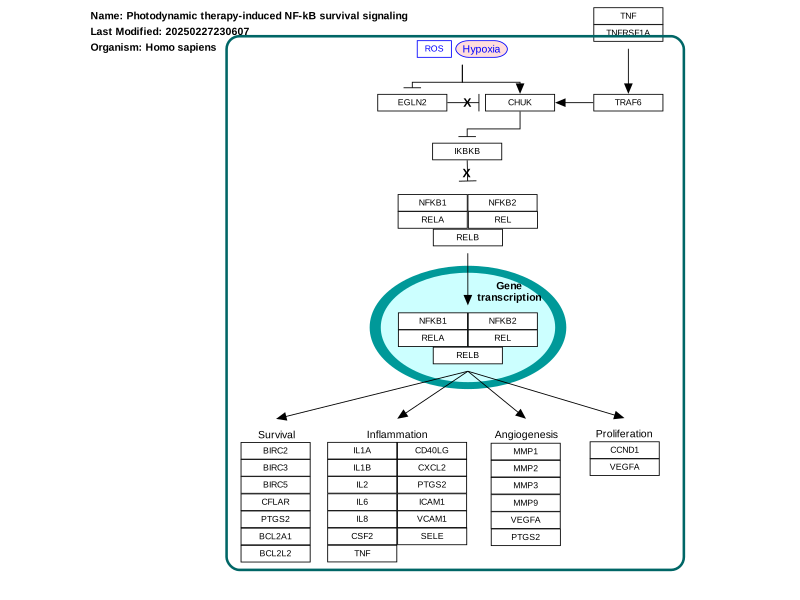
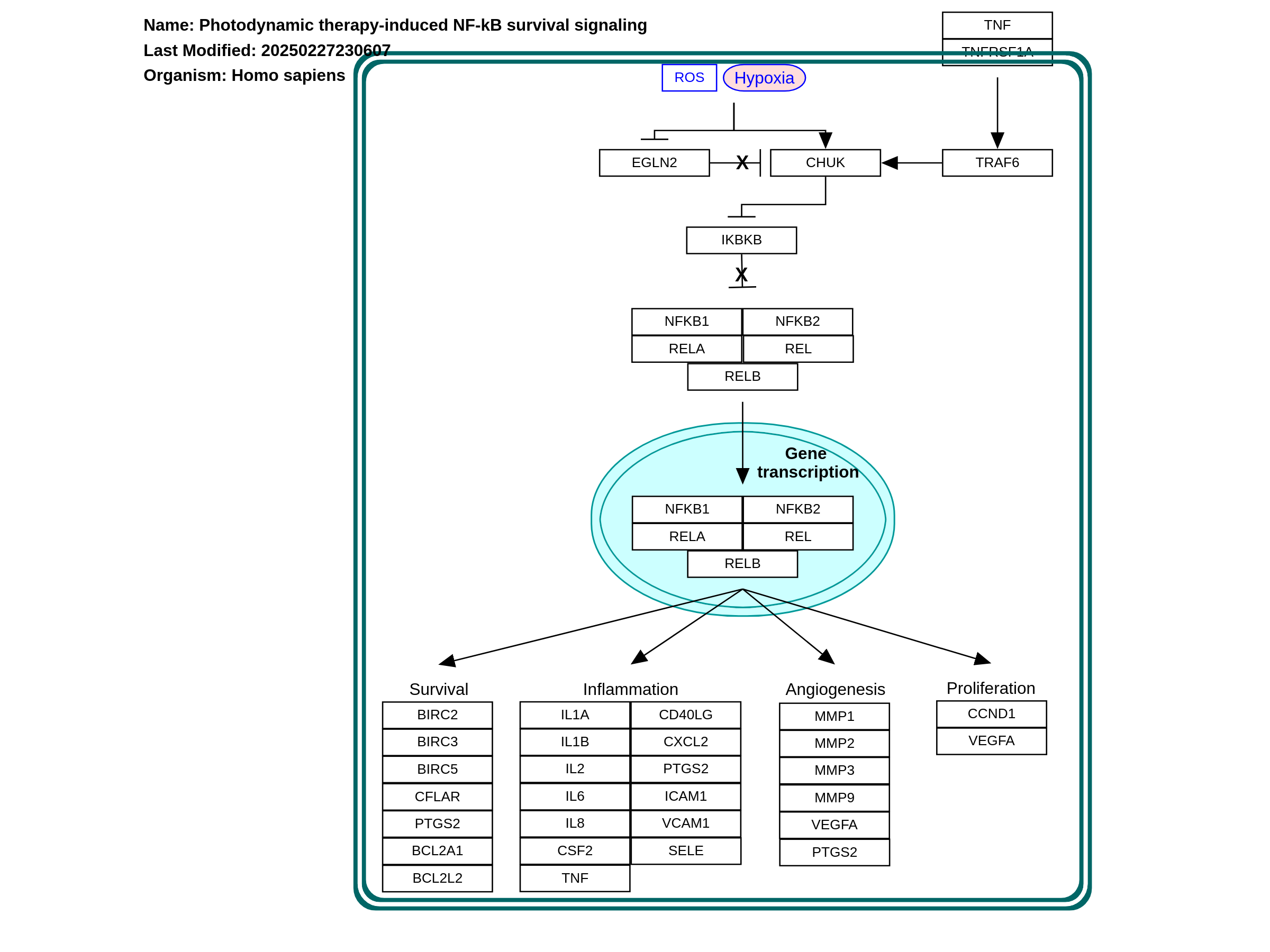

Photodynamic therapy may induce a pro-inflammatory and angiogenic response mediated by NF-κB. Proteins on this pathway have targeted assays available via the CPTAC Assay Portal.
For a description of pathway objects, see the WikiPathways Legend.
Authors
Ruud Weijer , Kristina Hanspers , Alex Pico , Friederike Ehrhart , and Eric WeitzActivity

Discuss this pathway
Check for ongoing discussions or start your own.
Cited In
- Identifying Drug-Induced Liver Injury Associated With Inflammation-Drug and Drug-Drug Interactions in Pharmacologic Treatments for COVID-19 by Bioinformatics and System Biology Analyses: The Role of Pregnane X Receptor (2022).
- Investigating the Molecular Processes behind the Cell-Specific Toxicity Response to Titanium Dioxide Nanobelts (2021).
- A Network-Based Analysis Reveals the Mechanism Underlying Vitamin D in Suppressing Cytokine Storm and Virus in SARS-CoV-2 Infection (2020).
- Network-based identification genetic effect of SARS-CoV-2 infections to Idiopathic pulmonary fibrosis (IPF) patients (2020).
- Wound-Healing Markers Revealed by Proximity Extension Assay in Tears of Patients following Glaucoma Surgery (2018).
- Systems biology approach reveals a common molecular basis for COVID-19 and non-alcoholic fatty liver disease (NAFLD) (2022).
- Exploring the pharmacological mechanism of Duhuo Jisheng Decoction in treating intervertebral disc degeneration based on network pharmacology (2023).
- Identification of host genomic biomarkers from multiple transcriptomics datasets for diagnosis and therapies of SARS-CoV-2 infections (2023).
- A Practical Strategy for Exploring the Pharmacological Mechanism of Luteolin Against COVID-19/Asthma Comorbidity: Findings of System Pharmacology and Bioinformatics Analysis (2024).
Are you planning to include this pathway in your next publication? See How to Cite and add a link here to your paper once it's online.
Organisms
Homo sapiensCommunities
CPTACAnnotations
Pathway Ontology
altered regulatory pathwayDisease Ontology
cancer| Label | Type | Compact URI | Comment |
|---|---|---|---|
| ROS | Metabolite | chebi:26523 | |
| CSF2 | GeneProduct | ncbigene:1437 | |
| IL8 | GeneProduct | ncbigene:3576 | |
| IL6 | GeneProduct | ncbigene:3569 | |
| IL1B | GeneProduct | ncbigene:3553 | |
| IL1A | GeneProduct | ncbigene:3552 | |
| IL2 | GeneProduct | ncbigene:3558 | |
| VEGFA | GeneProduct | ncbigene:7422 | |
| CCND1 | GeneProduct | ncbigene:595 | |
| TNF | GeneProduct | ncbigene:7124 | |
| EGLN2 | GeneProduct | ncbigene:112398 | |
| IKBKB | GeneProduct | ncbigene:3551 | |
| CHUK | GeneProduct | ncbigene:1147 | |
| NFKB1 | GeneProduct | ncbigene:4790 | |
| RELA | GeneProduct | ncbigene:5970 | |
| REL | GeneProduct | ncbigene:5966 | |
| NFKB2 | GeneProduct | ncbigene:4791 | |
| TRAF6 | GeneProduct | ncbigene:7189 | |
| PTGS2 | GeneProduct | ncbigene:5743 | |
| ICAM1 | GeneProduct | ncbigene:3383 | |
| VCAM1 | GeneProduct | ncbigene:7412 | |
| CXCL2 | GeneProduct | ncbigene:2920 | |
| CD40LG | GeneProduct | ncbigene:959 | |
| SELE | GeneProduct | ncbigene:6401 | |
| TNFRSF1A | GeneProduct | ncbigene:7132 | |
| RELB | GeneProduct | ncbigene:5971 | |
| CFLAR | GeneProduct | ncbigene:8837 | |
| BIRC2 | GeneProduct | ncbigene:329 | |
| BIRC5 | GeneProduct | ncbigene:332 | |
| BIRC3 | GeneProduct | ncbigene:330 | |
| BCL2A1 | GeneProduct | ncbigene:597 | |
| BCL2L2 | GeneProduct | ncbigene:599 | |
| MMP3 | GeneProduct | ncbigene:4314 | |
| MMP9 | GeneProduct | ncbigene:4318 | |
| MMP2 | GeneProduct | ncbigene:4313 | |
| MMP1 | GeneProduct | ncbigene:4312 |
References
- Tumor cell survival pathways activated by photodynamic therapy: a molecular basis for pharmacological inhibition strategies. Broekgaarden M, Weijer R, van Gulik TM, Hamblin MR, Heger M. Cancer Metastasis Rev. 2015 Dec;34(4):643–90. PubMed Europe PMC Scholia
- Low-power photodynamic therapy induces survival signaling in perihilar cholangiocarcinoma cells. Weijer R, Broekgaarden M, van Golen RF, Bulle E, Nieuwenhuis E, Jongejan A, et al. BMC Cancer. 2015 Dec 26;15:1014. PubMed Europe PMC Scholia